











Playground Safety Mats UK | BS EN 1177 Certified | Rubber Playground Tiles | Free Delivery
3 products
3 products
Playground Safety Mats UK — BS EN 1177 certified rubber safety matting for schools, nurseries, parks, and private play areas. Free UK delivery. Expert technical support.
Every year, thousands of children in the UK are injured in playground falls. The NHS reports that playground injuries account for a significant proportion of all childhood A&E admissions, with the majority caused by impact with the ground surface. Proper playground safety matting, tested and certified to BS EN 1177:2018 — the UK and European standard for impact-attenuating playground surfacing — is the single most effective way to reduce serious injury risk from falls.
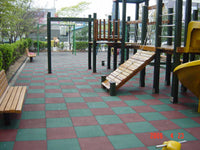
Rubberco supplies a full range of playground safety mats, rubber playground tiles, and impact-absorbing rubber surfacing for schools, nurseries, local authorities, sports clubs, and homeowners across the UK. All products are selected to meet or exceed BS EN 1177 requirements for Critical Fall Height (CFH) protection.
BS EN 1177:2018 is the British and European Standard specifying how playground surfaces must perform in the event of a child falling. It defines the Critical Fall Height (CFH) — the maximum height from which a child can fall onto a surface without a high risk of fatal head injury. The standard uses two measures:
Any playground safety surface used under equipment in the UK should be tested to BS EN 1177. While there is no absolute legal mandate, RoSPA strongly recommends compliance, and local authorities, schools, and insurers typically require it. Note: ASTM F1292 is a US standard and is not equivalent to BS EN 1177. Always specify BS EN 1177 when sourcing playground matting for UK installations.
| Mat Type | Thickness | Critical Fall Height | Best For |
|---|---|---|---|
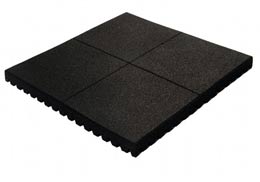
| Rubber Safety Tiles (Standard) | 25mm | Up to 1.0m | Toddler areas, low equipment |
| Rubber Safety Tiles (Medium) | 40mm | Up to 1.5m | Primary school play equipment |
| Rubber Safety Tiles (Heavy Duty) | 55mm | Up to 2.0m | Climbing frames, junior equipment |
| Rubber Safety Tiles (High Impact) | 65–80mm | Up to 3.0m | High-level equipment, secondary schools |
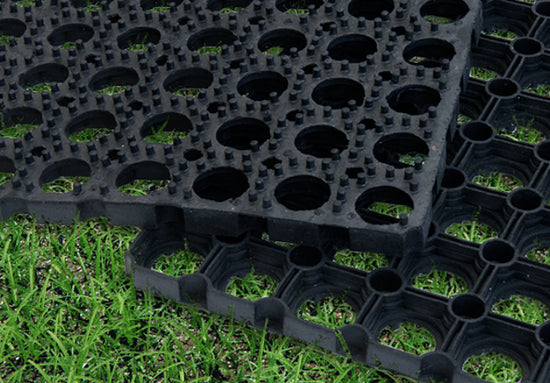
| Rubber Grass Mats | 23mm | Up to 1.2m | Grass protection & light impact |
Always match the mat thickness and CFH rating to the highest fall point of the equipment. For equipment over 2.0m, we recommend consulting a certified play area inspector (RPII) to determine the correct specification.
The impact zone extends beyond the edge of play equipment. RoSPA and BS EN 1176 (the equipment standard) recommend that impact-absorbing surfacing should extend at least 1.5 metres beyond the play equipment's maximum reach or overhang in all directions. For slides, the zone should extend to the length of the equipment.
Example calculation for a swing set:
If you're unsure about quantities or specifications, contact our team — we're happy to advise based on your equipment dimensions and required CFH.
Are your playground mats BS EN 1177 certified?
Yes. Our playground safety tiles are tested and certified to BS EN 1177:2018, the UK and European standard for impact-attenuating playground surfacing. All relevant test certificates are available on request.
What's the difference between BS EN 1177 and ASTM F1292?
BS EN 1177 is the UK/European standard; ASTM F1292 is the US equivalent. For UK installations, always specify BS EN 1177. Some suppliers quote ASTM compliance for products designed for the US market — this is not equivalent and does not satisfy UK/EU requirements.
What fall height do your playground mats protect against?
It depends on thickness. Our 25mm tiles cover CFH up to 1.0m; 40mm up to 1.5m; 55mm up to 2.0m; 65–80mm up to 3.0m. Contact us with your equipment specifications for exact recommendations.
Can playground mats be installed on grass?
Yes — our interlocking playground tiles can be laid directly on compacted, level grass or soil without adhesive. For permanent installations, we recommend a prepared sub-base (compacted MOT Type 1 with a sand blinding layer) to prevent ground movement and maintain drainage.
Are playground mats suitable for schools and nurseries?
Absolutely. Our tiles are used extensively by primary schools, secondary schools, nurseries, and council-managed parks throughout the UK. All products meet BS EN 1177 requirements. We can provide documentation for planning and procurement purposes.
How do I clean playground safety mats?
Regular hosing down removes surface dirt and debris. Use a mild disinfectant solution periodically for hygiene. Our rubber tiles do not harbour bacteria in the same way loose-fill materials can, and they won't wash away in heavy rain.
Can I order playground mats in custom sizes?
Our standard tiles are 1m × 1m or 500mm × 500mm. Bespoke sizes, borders, and ramp edges can often be accommodated — contact us to discuss your requirements.
What's the lifespan of rubber playground tiles?
Properly installed rubber playground tiles typically last 15–25 years under school or park conditions. Unlike bark chip or rubber crumb loose fill, there's no degradation, compaction, or topping-up required.
Do playground mats need to be fixed down?
In most domestic and temporary installations, the weight of interlocking tiles holds them in place without adhesive. For permanent public installations, bonding to a concrete or tarmac sub-base with polyurethane adhesive is recommended to meet public liability standards.
Are your playground tiles made from recycled rubber?
Yes — our standard playground tiles use recycled SBR (Styrene-Butadiene Rubber) as the primary material, helping reduce landfill waste. This does not compromise safety performance or BS EN 1177 certification.
Verified reviews from UK buyers
































Dispatch in 24 Hours
Satisfaction Guarantee
Secure Payments
sales@rubberco.co.uk


