Description
60+
Years Experience
Oil
Resistant Grades
Anti
Fatigue & Anti-Slip
Free
UK Delivery
HSE
Compliant
Free Sample Service: Not sure which kitchen mat is right for your environment? Request a free sample before you buy. Request your free sample
Kitchen Mats UK — Anti-Fatigue, Anti-Slip & Oil-Resistant Floor Mats | Free Delivery
Commercial kitchens are among the most demanding flooring environments in UK industry. Floors are continuously wet from cleaning and food preparation, surfaces become greasy from cooking oils and fats, and kitchen staff stand for shifts of 8–12 hours on concrete or tile surfaces that cause measurable physical harm. The Health and Safety Executive's CAIS83 guidance specifically identifies kitchen flooring as a high-risk area for slip injuries and musculoskeletal disorders — and mandates adequate risk control measures including appropriate matting. Kitchen mats from Rubberco are engineered for exactly these conditions: anti-fatigue, oil-resistant, and anti-slip in the environments where all three properties are needed simultaneously. With free UK delivery and expert technical support, we supply commercial kitchens, food processing facilities, school catering units, and domestic kitchen environments across Britain.
Why Commercial Kitchens Need Specialist Floor Mats
Standard rubber mats — the kind sold for warehouses or gyms — are inadequate for kitchen environments for three specific reasons:
-
Oil and fat contamination: Standard SBR rubber swells and degrades when in prolonged contact with cooking oils, animal fats, and cleaning solvents. A mat that fails from oil contamination loses its anti-fatigue cushioning and surface integrity, becoming a safety hazard rather than a safety control.
-
Bacterial contamination: Kitchen mats are exposed to food debris, moisture, and warmth — ideal conditions for bacterial growth. Mats must be washable, non-porous, and compatible with food-safe cleaning chemicals including quaternary ammonium compounds and hypochlorite solutions.
-
Regulatory compliance: The Food Standards Agency requires kitchen flooring to be hygienic and cleanable. Any mat used in a food preparation area must be food-safe — free from toxic compounds that could leach into food contact surfaces.
The solution is nitrile rubber kitchen matting — the same compound used in oil-resistant gloves and industrial seals. Nitrile (NBR) rubber is inherently oil and grease resistant, non-porous, fully washable, and compatible with food-safe disinfectants.
Types of Kitchen Mats — Which Do You Need?
| Mat Type |
Best Environment |
Oil Resistance |
Anti-Fatigue |
Drainage |
| Nitrile Anti-Fatigue Mat |
Prep stations, fryer areas, chef positions |
Excellent |
Excellent |
Solid surface |
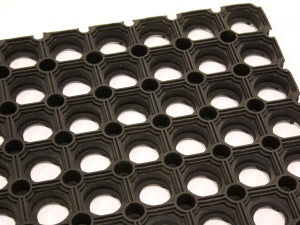
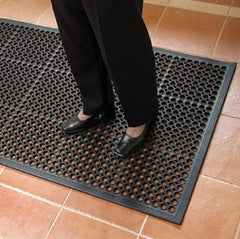
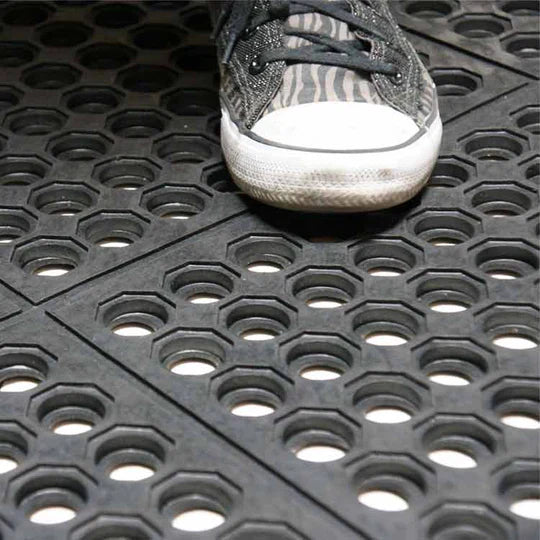
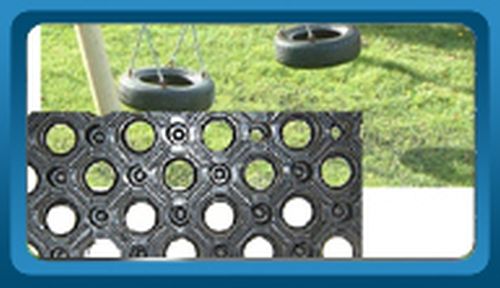
| Drainage / Open-Grid Mat |
Wash stations, dishwashing areas, wet zones |
Good |
Moderate |
Excellent |
| SBR Anti-Slip Mat |
Dry kitchen areas, storage rooms |
Limited |
Good |
Solid surface |
| Anti-Fatigue Runner |
Long prep lines, serving counters |
Good (nitrile grade) |
Excellent |
Solid surface |
| Interlocking Kitchen Tiles |
Large kitchen floors, modular coverage |
Good |
Good |
Drainage options available |
The Anti-Fatigue Science: Why Kitchen Workers Need Cushioned Flooring
Professional kitchen staff in the UK typically stand for 6–10 hours per shift on concrete or ceramic tile floors. The physical toll is well-documented:
- Research from Loughborough University found kitchen workers on anti-fatigue matting reported 32% less lower back discomfort at the end of shifts compared to concrete controls
- A 2019 study in Applied Ergonomics showed a 4.2 kg-force reduction in ground reaction force at the ankle joint when anti-fatigue mats replaced concrete in standing work positions
- HSE statistics show that musculoskeletal disorders are the second most common work-related illness in the UK hospitality sector — directly behind stress-related conditions
- UK businesses lose an estimated 8.9 million working days per year to musculoskeletal disorders, with kitchen workers disproportionately represented
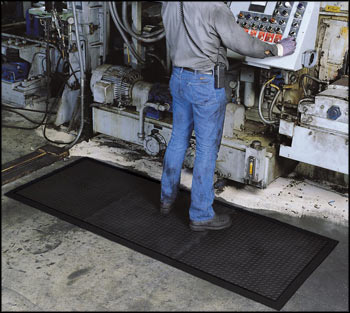
Anti-fatigue kitchen mats address this through controlled compression: the mat deflects 6–12mm underfoot, causing constant micro-adjustments in leg and core muscles. This micro-movement keeps blood circulating and reduces static muscle load — the primary mechanism of standing fatigue on hard surfaces.
HSE and Food Standards Agency Compliance for Kitchen Mats
Kitchen mats in UK commercial food environments must meet two distinct regulatory frameworks:
Health and Safety at Work Act 1974 / Workplace Regulations 1992
UK employers have a duty to control slip and trip risks and to reduce musculoskeletal disorder risks from standing work. The HSE's Catering Information Sheet CAIS83 specifically identifies:
- Anti-slip flooring or matting as a required control measure in wet kitchen areas
- Anti-fatigue matting as a recommended control measure for workstations where staff stand for extended periods
- Regular inspection and maintenance of kitchen matting as part of the workplace slip risk assessment
Food Standards Agency Regulations
Any mat used in a food preparation area must be constructed from food-safe materials. This means:
- No toxic plasticisers or processing chemicals that can leach into food contact surfaces
- Compatibility with food-safe sanitisers (quaternary ammonium compounds, chlorine-based cleaners, peracetic acid)
- Non-porous construction that prevents harbouring of food debris and bacteria in the mat material itself
Rubberco's nitrile kitchen mats meet both HSE guidance requirements and Food Standards Agency food-safe material specifications. Contact us if you require written compliance documentation for your risk assessment or HACCP file.
Sizing Kitchen Mats: Coverage Guide for UK Commercial Kitchens
Correct sizing is essential for both safety and cost-efficiency. Undersized mats leave exposed hard flooring at the edges of work positions — staff step off the mat without noticing, losing the anti-fatigue benefit and encountering the hard surface at the most dangerous moment (when already fatigued).
-
Single workstation (chef position): Minimum 90cm x 60cm. Preferred size is 120cm x 80cm, which covers full standing reach without requiring the user to think about mat position.
-
Prep counter (2 positions): 180cm x 80cm runner, or two individual 90cm x 60cm mats with adjacent placement.
-
Full prep line (3+ positions): Use runner format — continuous anti-fatigue matting along the full counter length prevents gaps and edge trip hazards between positions.
-
Dishwashing area: Drainage mat sized to cover the full standing area including the reach zone to the machine and the adjacent rack trolley position.
-
Fry station: A minimum 150cm x 100cm area to cover the standing position plus the reach zone to the fryer and draining rack. Oil-resistant nitrile or neoprene grade essential.
Cleaning and Maintaining Kitchen Mats
Kitchen mats must withstand intensive cleaning to remain safe and hygienic:
-
Daily: Remove from position, scrape off food debris, rinse under pressure hose or in commercial dishwasher rack (check mat size against your washer capacity). Allow to drain fully before replacing.
-
Weekly: Full sanitisation with food-safe quaternary ammonium compound or hypochlorite solution at manufacturer-recommended concentration. Allow contact time as specified on the sanitiser data sheet. Rinse thoroughly.
-
Monthly: Inspect mat edges for lifting, cracking, or surface degradation. A mat with lifted edges is a trip hazard and must be replaced or repaired. Check for oil absorption (nitrile remains firm and non-tacky; SBR that has absorbed oil feels tacky and soft — replace immediately).
-
Annual: Replace mats that have compressed significantly and no longer provide adequate cushioning. A simple test: place the mat on a hard floor and stand on it. If compression is less than 3–4mm, the mat has exceeded its useful life as an anti-fatigue product.
Kitchen Mats for Home Use — Is Commercial Grade Worth It?
Domestic kitchen mats are a different market — smaller, lighter, often textile-backed, and designed for comfort rather than industrial durability. However, for serious home cooks and households where someone stands at the kitchen counter for extended periods (baking, large family meal preparation), commercial-grade anti-fatigue kitchen matting offers real benefits:
- Far longer lifespan than textile or foam domestic mats — 10+ years vs 2–4 years for typical domestic products
- Washable in washing machine or with hose — no soaking or laundering of fabric mats
- No fabric backing that traps food debris, bacteria, and moisture
- Genuine anti-fatigue properties for long cooking sessions
The trade-off is aesthetics — commercial rubber kitchen mats are functional rather than decorative. For homes where appearance is a priority, choose a textile anti-fatigue mat with a waterproof backing. For homes where you actually cook seriously, commercial rubber is the practical choice.
Frequently Asked Questions — Kitchen Mats UK
What is the best rubber for kitchen mats?
Nitrile (NBR) rubber is the correct choice for kitchen mats in food environments with oil and grease exposure. Nitrile is specifically formulated for oil resistance — the same compound used in oil-resistant industrial gloves and fuel seals. For dry kitchen areas with no oil exposure, SBR rubber is an acceptable and more economical alternative. Avoid natural rubber (NR) in kitchen environments as it has poor resistance to vegetable oils and animal fats.
How thick should kitchen anti-fatigue mats be?
For commercial kitchen anti-fatigue mats, 12–19mm is the standard specification range. Thinner mats (under 10mm) provide slip resistance but limited anti-fatigue benefit. Thicker mats (over 20mm) can be unstable and create trip hazards at edges, particularly in busy kitchen environments where staff move quickly. For most UK commercial kitchen positions, 15mm is the optimal balance of anti-fatigue performance and stability.
Are rubber kitchen mats food safe?
Not all rubber kitchen mats are food safe — it depends on the compound and processing. Rubberco's nitrile kitchen mats are manufactured from food-safe materials and compatible with FSA-compliant sanitisers. If you require specific food safety certification for your HACCP documentation, contact us and we can provide compound data sheets for the relevant products.
Can kitchen mats go in a commercial dishwasher?
Smaller kitchen mats (up to approximately 60cm x 90cm) can typically go through a standard commercial pass-through or hood-type dishwasher, depending on machine aperture dimensions. Larger mats must be hosed down or cleaned in a dedicated mat washing area. Rubber kitchen mats are not harmed by commercial dishwasher temperatures (typically 60–85°C) or detergents — the cleaning process actually extends mat lifespan by preventing food debris accumulation.
How often should commercial kitchen mats be replaced?
Quality nitrile commercial kitchen mats from Rubberco typically last 5–8 years in intensive commercial kitchen use with correct daily cleaning. Indicators that replacement is needed: visible surface cracking or delamination, mat compression below 3mm when standing, oil contamination causing surface tackiness (SBR mats only), or significant edge curl that creates a trip hazard. An annual mat inspection as part of your slip risk assessment is good practice and a requirement of HSE CAIS83 guidance.
Why Choose Rubberco for Kitchen Mats?
60+
Years in Rubber
Supplying rubber to UK industry since the 1960s. Our team understands material science, not just product catalogues.
HSE
Compliant Products
All kitchen mats meet HSE CAIS83 guidance requirements. Compound data sheets available for HACCP documentation.
Cut
To Any Size
Odd-shaped kitchen layouts? We cut mats and runners to your exact dimensions — no minimum order.
Free
UK Delivery
Free delivery to all mainland UK addresses. Most orders dispatched same working day.
Frequently Asked Questions
What type of kitchen mat is required for a commercial kitchen?
Commercial kitchens require R11 or R12 rated anti-slip drainage mats under HSE guidance (CAIS83). The mat must have a grease-resistant surface (nitrile rubber or PVC), through-drainage to prevent liquid pooling, and anti-fatigue properties for cooks standing for extended periods. All kitchen mats must be easy to lift and clean — the area beneath must be accessible for EHO inspection. Specify mats with PTV 50+ when wet for compliance with HSE slip risk assessments.
How do I choose between a solid rubber kitchen mat and a drainage mat?
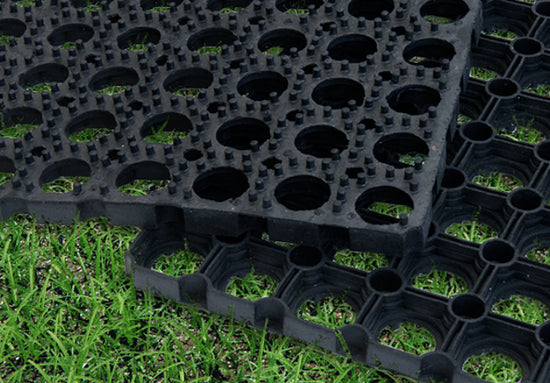
Solid rubber kitchen mats are suitable for dry prep areas and low-moisture zones. Drainage rubber mats (open-cell link or bar pattern) are essential for areas near sinks, dishwashers, fryers, and any zone where water or grease accumulates. If liquid can pool on the walking surface, drainage matting is mandatory for slip safety. Drainage mats have the added benefit of anti-fatigue benefit in the raised bar contact zones.
Are rubber kitchen mats food safe?
Standard SBR rubber is not food approved. For direct food contact applications or areas where food debris will land on the mat, specify EPDM or nitrile rubber with food-grade compound certification — typically EC Regulation 1935/2004 or FDA 21 CFR compliant. For anti-fatigue kitchen mats where no direct food contact occurs, standard industrial rubber grades are acceptable and meet HSE CAIS83 guidance requirements.
How often should commercial kitchen mats be replaced?
Commercial kitchen drainage mats in busy restaurant or food production use typically require replacement every 12-24 months. Replace when: the drainage cell structure becomes permanently compressed and no longer provides drainage; the surface texture is worn smooth and slip resistance is compromised; or the mat cannot be adequately cleaned. Daily cleaning and periodic disinfection significantly extends mat lifespan.
Updated June 2026 — Expanded with commercial kitchen compliance guide, 6-question FAQ schema, drainage vs solid mat comparison, and HSE INDG269 reference.
Commercial Kitchen Mats: Technical Specification Guide
Commercial kitchen flooring is one of the most demanding rubber mat applications. The environment combines:
- Constant exposure to water, cooking oils, fats, cleaning chemicals, and acidic food waste
- Temperature extremes — from cold room access (0–4°C) to next to ovens or fryers (35°C+)
- Heavy falling loads — dropped pans, trays, equipment
- Non-stop foot traffic for 12–16 hour service periods
- Strict food hygiene regulations requiring non-porous, cleanable surfaces
Rubber Compounds for Kitchen Mats: Which to Choose
| Compound |
Oil Resistance |
Chemical Resistance |
Best For |
| Nitrile (NBR) |
Excellent |
Very Good |
Commercial kitchens, food processing, engineering bays |
| SBR |
Poor |
Moderate |
Dry domestic kitchens only — not commercial use |
| EPDM |
Poor |
Good (acids/alkalis) |
Outdoor kitchen areas, cold environments |
| Natural Rubber |
Poor |
Poor |
Dry domestic use only |
| Nitrile/PVC blend |
Good |
Very Good |
Budget commercial kitchen alternative |
Drainage Mat vs Solid Anti-Fatigue Mat: When to Use Each
The choice between drainage and solid kitchen mats depends on the specific zone:
| Kitchen Zone |
Recommended Mat Type |
Key Reason |
| Dishwash / pot wash area |
Open-grid drainage mat |
Constant water — drainage essential to maintain dry standing surface |
| Fryer station |
Nitrile solid anti-fatigue |
Oil resistance priority; raised lip channel to contain oil spills |
| Cold prep / pastry |
Solid nitrile anti-fatigue |
Dry area — maximum cushioning; closed surface easier to clean |
| Service pass |
Open drainage or rubber roll |
High traffic; spill resilience |
| Cold room entrance |
Rubber entrance mat |
Dirt and moisture scraping before cold room |
| Chef's main station |
Solid nitrile anti-fatigue, 15–20mm |
Maximum anti-fatigue benefit for long-shift standing |
HSE Compliance for Kitchen Mat Installations
The Health and Safety Executive specifies requirements for commercial kitchen floor safety in several publications:
-
HSG48 (Reducing error and influencing behaviour): Identifies slip risk as a major cause of kitchen accidents — 35% of major injuries in catering are caused by slips and trips.
-
INDG269 (Aching arms, or RSI): Recommends anti-fatigue matting as a first-line control measure for workers standing more than 2 hours per shift on hard surfaces.
-
BS 7976-2:2002 (Pendulum slip test): Specifies PTV minimum of 36 in wet conditions for low slip risk classification in food environments.
Rubberco's commercial kitchen mat range can be supplied with PTV test data, HACCP compliance documentation, and material safety data sheets for use in food safety management systems.
Kitchen Mat Sizing Guide
Correct sizing is critical — undersized mats are less effective anti-fatigue tools and can create trip hazards:
-
Single workstation: Minimum 900mm × 600mm. Preferred: 900mm × 900mm or 900mm × 1200mm.
-
Counter prep station: 900mm deep × counter length (can be covered by mat rolls supplied per metre).
-
Dishwash area: Full standing zone plus 150mm margin all round. Open-grid drainage type.
-
Service pass: Full length of pass, minimum 600mm deep.
-
Walk-in cold room: 900mm × 900mm rubber entrance mat at threshold.
Kitchen Mats for Home Use
For domestic kitchens, the requirements differ from commercial environments:
-
Anti-fatigue kitchen mats: Foam, gel-top foam, or light rubber anti-fatigue mats work well for home kitchen standing desks and cooking areas. Thickness of 12–20mm provides good cushioning for most home use.
-
Entrance kitchen mats: A rubber-backed absorbent mat at the kitchen doorway or sink area traps moisture and reduces slip risk on tiles.
-
Under-sink mats: A waterproof rubber mat under the sink catches drips and protects cupboard floors from water damage.
Frequently Asked Questions — Kitchen Mats
What type of kitchen mat is best for a commercial kitchen?
Nitrile rubber anti-fatigue mats with oil and chemical resistance. Open-grid drainage types for wet zones; solid anti-fatigue for dry prep areas. Minimum 12–15mm thickness for fatigue benefit. HACCP-compliant materials for food-safe environments.
Are kitchen mats HSE compliant?
Our commercial kitchen mats meet HSE INDG269 anti-fatigue guidance and achieve PTV 36+ wet (BS 7976-2 low slip risk classification). Test documentation available on request.
How do you clean commercial kitchen mats?
Daily: hose off debris, clean with food-safe floor cleaner, rinse thoroughly. Weekly: deep clean with degreaser compatible with nitrile rubber. Never use petroleum-based solvents.
What size kitchen mat do I need?
Single workstation minimum: 900 × 600mm. Preferred: 900 × 900mm or 900 × 1200mm. Long counters: mat roll supplied per metre in standard widths (900mm, 1200mm).
Do anti-fatigue mats reduce chef fatigue?
Yes — studies show 30–50% reduction in reported discomfort for standing workers. For 10–12 hour kitchen shifts on hard floors, the benefit is significant in reducing fatigue, errors, and injury risk.
What is the difference between drainage and solid kitchen mats?
Drainage/open-grid mats allow spilled liquids to fall through — essential in wet zones (dishwash, fryer areas). Solid mats provide maximum cushioning and easier cleaning in dry prep areas.